A seller in an older Pacific Beach condo building lists this fall, expecting the kind of clean, fast close that coastal inventory usually gets. The buyer is qualified. The appraisal comes in fine. Then the transaction stalls, not because anything is structurally wrong with the unit, but because nobody in the HOA office can produce one specific document: the balcony inspection report the association was supposed to complete back in January 2025.
That scenario is becoming common enough in San Diego's condo market to be worth understanding before you list, not after your buyer's lender asks for a document your HOA doesn't have.
Here's the part most owners still don't know. The balcony inspection deadline itself is old news. What changed is what happens to that report once you decide to sell.
Two Laws, One Year of Confusion
California passed two related balcony safety laws after the 2015 Berkeley balcony collapse that killed six people. SB 721 covers apartment buildings. SB 326, codified at Civil Code section 5551, covers condominium associations and other common interest developments.
The two laws do not run on the same clock, and that difference is where a lot of San Diego HOA boards got tripped up. When the legislature passed AB 2579 and pushed the apartment deadline under SB 721 out to January 1, 2026, plenty of condo board members assumed their deadline moved too. It didn't. The SB 326 deadline for condominium associations stayed put at January 1, 2025, with no extension. Any HOA that hasn't completed its first inspection is not in a grace period. It is simply late.
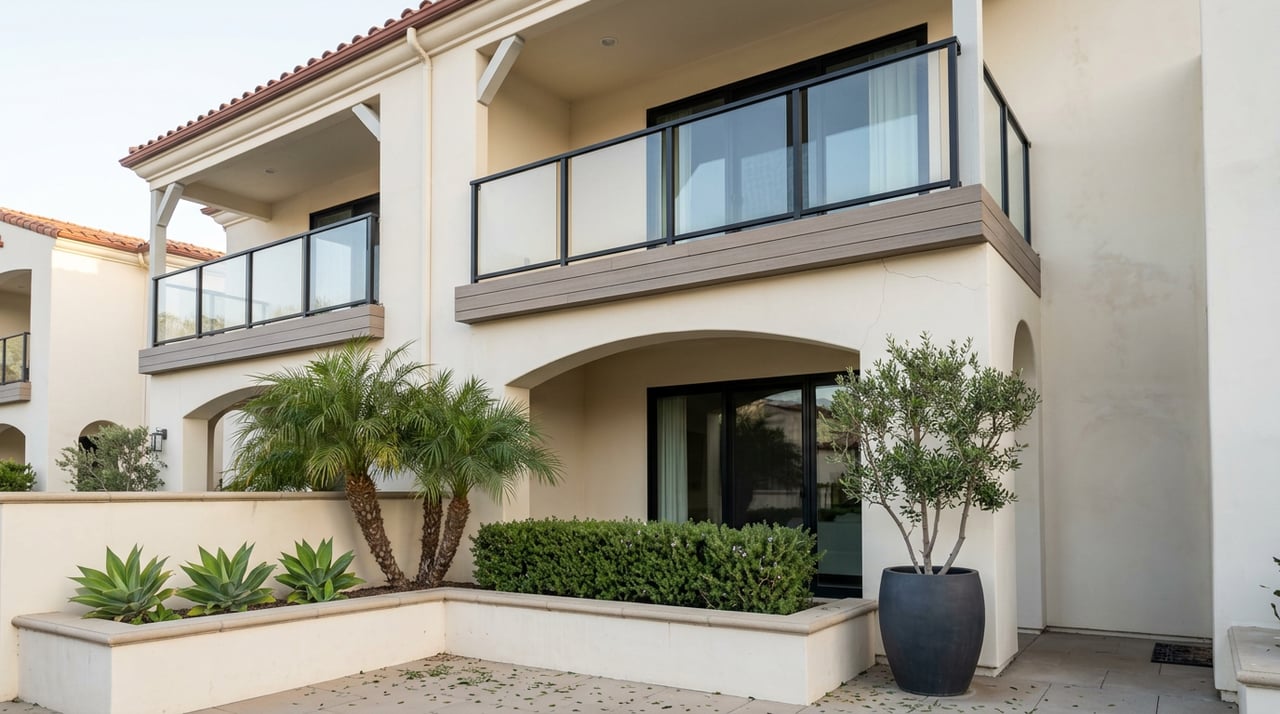
The inspection itself is specific: a licensed structural engineer or architect (California added licensed civil engineers to the approved pool through AB 2114) has to physically examine a statistically significant sample of every wood-framed balcony, deck, stairway, and walkway more than six feet above ground, defined in the statute as a sample large enough to produce 95 percent confidence with a margin of error no greater than 5 percent. The report gets folded into the HOA's reserve study, and any element posing an immediate safety risk has to be flagged to local code enforcement within 15 days.
None of that is new information if you've followed HOA compliance news over the past year. What's new is what happens when you try to sell.
What SB 410 Actually Added
Effective January 1, 2026, SB 410 amended Civil Code section 4525, the statute that lists exactly what a seller has to hand a buyer during a California condo resale. Before this year, a buyer typically had to ask for the SB 326 report separately, through a records request or a lender questionnaire. Now the most recent inspection report is a required line item in the standard disclosure packet, the same packet that includes the CC&Rs, the budget, and the assessment history.
That sounds like a paperwork tweak. In practice it changes who owns the problem. A missing or overdue report used to be an HOA governance issue that a buyer might never see. Now its absence is itself a disclosure item, and a buyer's agent who knows what they're looking at will flag it before removing contingencies. As one California real estate attorney put it in describing this exact dynamic, the inspection duty sits with the association, but when the paperwork isn't there, it's the individual owner trying to close who ends up eating the delay.
Where San Diego Feels This Differently
San Diego County already carries the country's heaviest concentration of HOA-governed housing, with 55.2 percent of homes carrying an HOA fee and a countywide median monthly cost of $360, according to industry reporting from early 2026. But the risk this law creates isn't evenly spread. It clusters around age of construction and, along the coast, the specific way salt air and moisture attack wood over time.
| Area | What's Driving Exposure | What to Ask Before You Remove Contingencies |
|---|---|---|
| Pacific Beach (Ocean Front Walk corridor) | Named in 2026 industry reporting as a concentration point for older buildings facing balcony compliance costs and special-assessment pressure | Has the building completed its SB 326 inspection, and what did it find? |
| Mission Beach (Mission Boulevard high-rises) | Same reporting flags this corridor's older high-rise stock for compliance and assessment exposure | Is there a pending or announced special assessment tied to EEE repairs? |
| Downtown (Little Italy, East Village mid-rises) | Mixed-age mid-rise stock also named as a compliance-cost concentration point | Does the reserve study reflect the inspection findings, or predate them? |
| La Jolla, Del Mar, Coronado, Ocean Beach | Persistent salt-laden marine air accelerates corrosion of fasteners and joist hangers, the exact hardware SB 326 inspections scrutinize | Ask specifically about railing and connector condition, not just visible wood |
| Escondido, San Marcos, Santee, El Cajon | Expansive clay soils and slab movement can stress stairways and elevated walkways tied into the structure | Confirm whether the inspection covered structural connections, not just surface wear |
Along the coast, the mechanism is fairly specific: persistent marine-layer moisture keeps wood framing damp longer than it would stay inland, which feeds the dry rot and fungal decay that can hollow out a balcony ledger from the inside without any visible sign from the unit. Inland, the story changes. Clay soils that expand and contract with moisture put stress on stairways and walkways in a way that has nothing to do with salt air and everything to do with what's moving underneath the foundation.
The Money Part Sellers Underestimate
In San Diego, the inspection itself is the cheap part. As of early 2026, local inspectors were reporting costs of roughly $300 to $500 per balcony, with total inspection budgets for a building landing somewhere between $2,000 and $20,000 depending on size. That's a rounding error compared to what happens when the inspection finds something.
Special assessments tied to deferred balcony and walkway repairs were landing in the $40,000 to $60,000 per unit range in buildings with real deferred maintenance, according to that same early-2026 reporting. Under California law, a special assessment attaches to the owner, not the property. That means if your building levies an assessment while you're in escrow, you're typically the one paying it at closing, not the buyer who's about to take over the unit.
There's also a financing angle that catches sellers off guard. Buildings that are mid-inspection or mid-repair under SB 326 can become temporarily non-warrantable under Fannie Mae and Freddie Mac guidelines, which pushes conventional buyers toward portfolio lenders with higher down payments and different terms. For veteran and active-duty buyers using VA financing, the exposure is structural rather than incidental: VA condo approval covers the entire building, not the individual unit, and getting a project VA-approved typically takes 30 to 60 days through the HOA. A building sitting on an incomplete SB 326 report is not in a strong position to clear that review quickly.
None of this means a condo with an overdue inspection is unsellable. It means the timeline you were expecting can move without warning, at the exact point in escrow when everyone wants speed.
Before You List: What to Ask Your HOA
If you're weighing a condo sale in San Diego this fall, get these answers before you sign a listing agreement, not after you're in contract:
- Has the association completed its SB 326 inspection, and do you have the actual report, not just a board statement that it happened?
- Does the report identify any items requiring emergency repair, and has that repair been completed?
- Has the HOA announced or discussed a special assessment tied to inspection findings?
- Does the current reserve study reflect the inspection results, or was it written before the inspection happened?
- If a buyer is financing with a VA or conventional loan, has the building's project eligibility been reviewed recently?
Getting these answers early doesn't just protect your timeline. It gives you leverage to negotiate price and terms from a position of knowing exactly what you're selling, rather than finding out mid-escrow along with everyone else.
A Few Questions Worth Answering Directly
Does this apply to my townhouse, not just a high-rise condo? It depends on ownership structure, not the word "townhouse." If your unit is part of a condominium association where the building itself is a shared, commonly owned structure, SB 326 and the SB 410 disclosure requirement apply. If you own the structure and lot outright as part of a planned development, they generally don't.
What if my HOA still hasn't done the inspection? You're not alone, and there's no direct fine written into SB 326 itself for a late HOA. But the practical consequences are real: lenders scrutinizing financing, insurance carriers asking questions at renewal, and now a disclosure gap that a buyer's agent is required to notice. Push your board to schedule the inspection as soon as possible if you're planning to list within the next year.
Does a clean report mean I'm in the clear? It means the building has documented, current-cycle proof of condition, which matters enormously to lenders and buyers. It doesn't guarantee no future assessment. The next inspection cycle is nine years out, and buildings age in the meantime.
San Diego's condo market rewards sellers who show up with their paperwork already assembled. If you're thinking about listing a condo or townhome anywhere from Pacific Beach to Rancho Bernardo, or you're trying to structure a competitive offer as a buyer navigating HOA documents for the first time, Tamara Krause can walk you through exactly what to request and when. Let's Connect.